
Murderer's Row
Or the unlikely leaders of the church at Antioch

Now in the church at Antioch there were prophets and teachers: Barnabas, Simeon called Niger, Lucius of Cyrene, Manaen (who had been brought up with Herod the tetrarch), and Saul. (Acts 13:1)
That is a pretty fascinating list of names to start a church with. So let’s do a roll call here.
We’ll start off with Barnabas. Now, Barnabas we know from earlier in Acts. He’s introduced back in chapter 4, and his real name is Joseph, or in some manuscripts Joses.1 But he’s given the nickname Barnabas, which means son of encouragement, because in his first appearance he sells a plot of land that he owns and brings the proceeds to the church in Jerusalem to share with the poor (Acts 4:36–37).
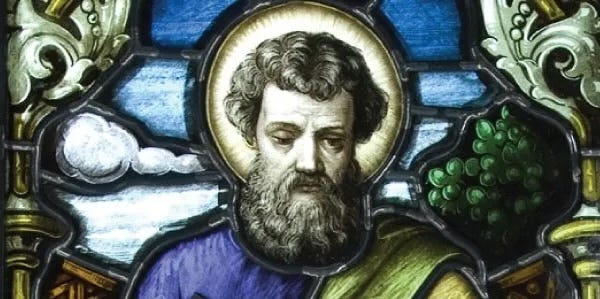
What’s interesting about Barnabas, and relevant for our story today, is that he is a Levite from Cyprus. And that tells us a couple of interesting things about him. First of all, he is thoroughly ethnically Jewish. In fact, he’s a Levite, so he’s from the tribe that cared for temple worship in Jerusalem within that Levitical system. But he is also part of the diaspora. He’s not living in Jerusalem near the temple. He’s from Cyprus, a little island off the coast of Syria, just north of Palestine, out in the Mediterranean Sea. And it’s this story of Jesus that seems to draw him back to his faith. So he sells his land and makes his way back to Jerusalem, all of this to be part of this emerging Jesus movement that’s happening.
Well then, how does he end up in Antioch? His background is probably a big clue to the story, because the church in Antioch is a bit of an anomaly in itself.
See, at the end of Acts chapter 7, persecution of the church breaks out in Jerusalem, and at its climax one of the early leaders, a man named Stephen, is killed. He’s actually martyred for his faith in Jesus (Acts 7:54–60). Now, who is there directing all of that violence? Well, it’s actually Saul, who we also know is Paul, who also finds himself on the list of leaders at Antioch, by the way. We’ll get to him in a moment, because like any good Avengers film, there’s a lot of interwoven threads going on right now.
But initially what happens is that, because of this violence, the church in Jerusalem disperses. In fact, at the start of chapter 8 we read that because of the violence, all except the apostles were scattered throughout Judea and Samaria (Acts 8:1). It’s actually Stephen’s death that inadvertently first spreads the good news beyond Jerusalem.
From there the story continues. In chapter 9, Saul has an encounter on the Damascus road and converts to the way of Jesus (Acts 9). In chapter 10, Peter has his encounter, his vision, meets Cornelius, and realizes that the story of Jesus extends beyond his ethnic boundaries (Acts 10). And then in chapter 11 we read that those who had been scattered by the persecution that broke out when Stephen was killed had travelled as far as Phoenicia, Cyprus, and Antioch:
Those who had been scattered travelled as far as Phoenicia, Cyprus and Antioch, spreading the word only among Jews. But then some of them, men from Cyprus and Cyrene, went to Antioch and began to speak to Greeks also, telling them the good news about the Lord. The Lord’s hand was with them, and a great number of people believed and turned to the Lord. (Acts 11:19–21)
When news of this reached the church in Jerusalem, they sent Barnabas to Antioch to see what was up (Acts 11:22).
So all these stories are kind of happening at the same time right now. Saul, also known as Paul, is converting to the way of Jesus. Peter is converting to the idea that salvation has been extended to non-Jewish people. And these scattered believers, completely independent of the apostles, are coming to a similar realization and just moving ahead, telling people about Jesus, starting churches completely on their own without the oversight of the disciples.
So the church in Jerusalem, which, remember, is full of all those OG apostles, hears about this and thinks, well, we should probably see what’s happening up there in Antioch. Let’s send someone to go check up on things. Who do we have? Well, we’ve got Barnabas here. We know he’s a good guy. He’s Jewish like us. And he’s already from Cyprus. He knows that area, he knows those people. Let’s send him north to do some reconnaissance.
Now, whether this is because the church in Jerusalem is skeptical of what’s happening, or whether they just want to encourage them, that’s up for speculation. Hard to know for sure. But I do think history shows they chose the right person, because as soon as he gets there, this is what we read: Barnabas arrived and saw what the grace of God was doing, and he was immediately glad and encouraged them (Acts 11:23). Which, if you remember, is exactly what the name Barnabas meant in the first place. The dude just does what he does.
So what does all this mean? Well, it means the church in Antioch is a related strain of Christianity. These were believers who first encountered the story of Jesus in Jerusalem, after all. But it’s almost like Antioch is a parallel evolutionary path of the story of the church. It develops not just in a different city, or even just a different culture and language, but in a very different way from the church in Jerusalem. It’s not founded by the disciples. It’s not built on the apostles. This is a ground-up, grassroots, lay-led explosion of good news.
Which is why, going back to chapter 13, we hear that the leaders of this new church include Barnabas, who we’ve just talked about, a displaced Jewish man drawn back to his faith by Jesus.
There’s Simeon called Niger, which is literally something like Simeon the black one,2 which to our ears probably sounds a little racially insensitive today, but is actually a very important point the writer is making here. The church is not what Jerusalem expected it to be. The church in Antioch is not even the complexion that Jerusalem expected to see.
There’s Lucius of Cyrene, a man we realistically don’t really know anything about, but who brings with him a very Roman name. This is not just a gentile. This is someone first-century Jewish people would have almost instinctively heard as enemy, because of that name.
And then Manaen, who had been brought up with Herod the tetrarch. That is a wild statement to read in the New Testament, because that is a reference to Herod Antipas, the same guy who ruled over Galilee3 and murdered John the Baptist a little earlier in the story (Mk 6:14–29). The language here identifies Manaen as a suntrophos of Herod,4 which could mean childhood friend, but realistically probably refers to what we might call a foster brother. These were young boys brought into the royal court and raised alongside royal princes, essentially so that the princes would have peers as they grew up. And that meant Manny was not at all part of the royal family, but he was raised in the royal court alongside the man who murdered the forerunner of Christ. Talk about guilt by association.
And yet here he is, leading the church in Antioch alongside the final name on our list, Saul, who today we primarily know by his Roman name, Paul. We’re used to hearing a lot about Paul, but you have to understand that at this point in the story Paul has been incommunicado for about a decade now. He left for Tarsus and Cilicia, and nobody has heard from him since. But in chapter 11, Barnabas goes to Tarsus to find him and brings him out of retirement to help found this church in Antioch (Acts 11:25–26).
This is a murderer’s row of characters listed here in chapter 13. If you’re into Marvel movies, this is more like the Thunderbolts than the Avengers, to be honest. And so if Peter thought his vision was a little destabilizing, just wait until Jerusalem gets a load of this. Barnabas the expendable one. Simeon the black one. Lucius the Roman one. Manaen the one guilty by association. And Saul the one we never really trusted anyway, but thankfully we hadn’t heard from him in a decade either.
That’s who’s leading a church that’s popped up in Antioch.
Now, don’t get me wrong. I’m all for credentials. I have worked really hard on my degrees, for example. I think if you want to lead, you should be willing to put in the work to learn first. But at some point, if the only people we are ever willing to follow are the people the establishment tells us we should, I think we will find that our communities lack the diversity of perspective and history and calling and creativity that characterizes the kingdom of God, and what the Spirit seems to do despite us.
Recently I wrote about Peter’s first sermon of the church era, where he quotes from the prophet Joel and talks about how God will pour out his Spirit on men and women, on young and old (Acts 2:17–18; Joel 2:28–29). And at the time I said that we are better when we listen to each other, that there is enough hierarchy in the world to last a lifetime, but it should not be that way in the community of Christ.5
Antioch is where the church antes up on that conviction.
cf. Codex Bezae
Joseph A. Fitzmyer, The Acts of the Apostles, The Anchor Yale Bible; (New Haven: Yale University Press, 1974), 496. see also “The reason for the surname, apart from its Latinity, can scarcely be in question; he was presumably of dark complexion.” F. F. Bruce, The Book of the Acts, NICNT;(Grand Rapids: Eerdmans, 1988), 244.↩︎
“Herod the Great, who ruled Galilee and Peraea as tetrarch from 4 B.C. to A.D. 39.” F. F. Bruce, The Book of the Acts, NICNT; (Grand Rapids: Eerdmans, 1988), 245.↩︎
“Manaen is a Greek form of Hebrew Menahem (meaning “comforter”). The title “foster-brother” was given to boys of the same age as royal princes, who were taken to court to be brought up with them.” F. F. Bruce, The Book of the Acts, NICNT; (Grand Rapids: Eerdmans, 1988), 245.